International Morse vs American Morse
Two codes, one name — but only International Morse matters for radio, exams, and learning today. Full timing comparison, letter differences, railroad history, and a standards-based comparison.
By MorseCoder · August 2026
Quick Answer: International vs American Morse
International Morse (Continental Code) uses fixed dot and dash lengths with standardized spacing — this is what ham radio, the ITU, Navy training, and morsecoder.us use. American Morse (Railroad Code) uses variable dashes and internal letter spaces (e.g., C = · · · ·). International won because it copies better over radio noise. Learn International only unless you are restoring a 19th-century telegraph line.
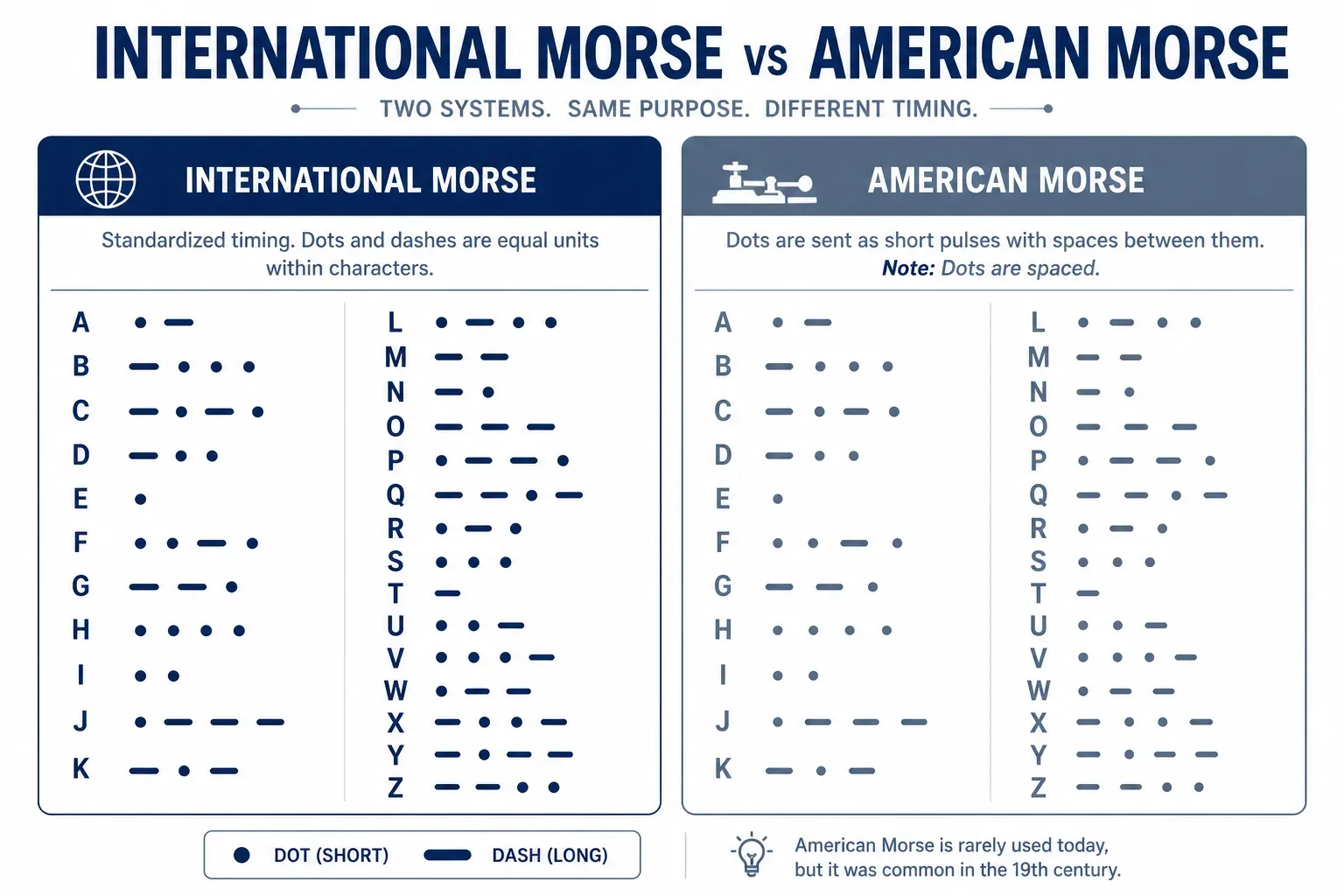
What is American Morse Code?
American Morse (Railroad Morse, Land-Line Morse) is the original telegraph code developed by Samuel Morse and Alfred Vail for wired land-line systems. It uses variable-length dashes and internal spaces within characters, making it more compact on paper tape but harder to learn and incompatible with radio-era timing standards.
What is International Morse Code?
International Morse (Continental Code) is the standardized dot-dash system adopted in Europe in 1851 and used worldwide for radio communication. Fixed timing — dot = 1 unit, dash = 3 units, inter-element gap = 1 unit — makes it the only code relevant for ham radio, aviation, military, and modern learning tools.
Side-by-Side Comparison
The fundamental differences between the two codes at a glance:
| Feature | American Morse | International Morse |
|---|---|---|
| Also known as | Railroad Code, Land-Line Morse | Continental Code, ITU Morse |
| Dash lengths | Variable (2, 3, or 4 unit dashes) | Fixed (always 3× dot length) |
| Internal spaces | Yes — within characters (e.g., C = · · · ·) | No — only between characters |
| Primary use (historical) | U.S. land-line telegraph, railroads | Submarine cable, wireless radio |
| Primary use (2026) | Museums, hobby restoration | Ham radio, Navy, aviation, learning |
| Standard document | None (obsolete) | ITU-R M.1677-1 |
| Learn today? | ❌ No — historical only | ✅ Yes — the only practical choice |
Timing Differences Explained
International Morse timing follows ITU-R M.1677-1: one dot (dit) = 1 time unit; one dash (dah) = 3 units; gap between elements within a character = 1 unit; gap between characters = 3 units; gap between words = 7 units. At 20 WPM, one dot lasts 60 milliseconds. This rigid structure lets your brain recognize "sound shapes" — the rhythm of each letter as a single unit.
American Morse timing has no single modern standard. Dashes varied in length (some operators describe "long" and "short" dashes). Internal spaces within characters — like the four spaced dots for C — added another dimension. On a land-line sounder, experienced operators recognized characters by the total pattern including pauses. That worked on quiet telegraph wires but fails on noisy radio channels where every pause might be static.
Letter & Symbol Differences
Many letters are identical or similar, but these show the most important divergences. Spaced dots (· ·) indicate internal gaps in American Morse. Our alphabet chart shows International codes with audio for every letter.
| Char | American Morse | International Morse | Note |
|---|---|---|---|
| C | · · · · | - · - · | American uses four spaced dots |
| O | — — | --- | American O is two long dashes, not three |
| R | · · · | · - · | American R is three spaced dots |
| L | — · — · | · - · · | Different dash/dot pattern |
| Y | — · — — | - · - - | American uses internal spaces |
| Z | — — · · | -- · · | Dash count differs |
| 0 | ————— | ----- | American zero is one continuous dash |
| 1 | · — | · ---- | American one is dot-dash only |
| 9 | —— · — | ---- · | Completely different structure |
| Period | · · — · — · | · - · - · - | American period has internal gaps |
Letters A, E, I, N, T are identical or nearly identical in both systems. The divergences concentrate in longer characters and all digits — another reason International standardization simplified global communication.
Why International Morse Won
Three forces pushed International Morse to global dominance between 1851 and 1920:
- European standardization (1851): Nations at the Dresden conference needed one code for cross-border telegraph traffic. Continental Code eliminated the ambiguity of American variable dashes.
- Submarine cables: Undersea operators needed reliable copy over noisy, high-latency lines. Fixed timing reduced misinterpretation.
- Wireless radio (1890s+): Marconi and others copied Morse through the air. Static, fading, and interference punish inconsistent timing. International Morse's rigid structure survives conditions that garble American internal spaces.
By World War I, International Morse was the only code used in military and maritime radio. American land-line Morse persisted on U.S. railroads and Western Union wires for a few more decades, but the future belonged to the code that could fly through the ether.
American Morse & the Railroad Era
U.S. railroads were among the last major users of American Morse. Telegraph lines ran alongside tracks, connecting depots, towers, and dispatch centers. Operators copied train orders, block signal reports, and emergency messages on sounders — the iconic clicking devices that popularized "dots and dashes" in American culture.
A skilled railroad telegrapher could send 25–40 words per minute in American Morse, often using abbreviations and procedural signals unique to rail operations. The code was optimized for their wire network, not for the radio frequencies that eventually replaced it.
Today, preserved railroad museums (like the Baltimore & Ohio Railroad Museum near the site of that first 1844 message) occasionally demonstrate American Morse on restored equipment. It is fascinating history — but not something you need for your Technician license or a CW QSO on 20 meters.
Which Code Should You Learn Today?
International Morse — exclusively. Every practical application in 2026 uses it:
- • Amateur radio CW (all bands, all contests)
- • U.S. Navy training (revived 2022)
- • Aviation VOR beacon identification
- • Emergency SOS signaling (... --- ...)
- • Google Gboard Morse input
- • Every tool on morsecoder.us
People Also Ask
What is Railroad Morse code?
Railroad Morse is another name for American Morse — the land-line telegraph code U.S. railroads used before radio dispatch.
What is Continental Code?
Continental Code is the European name for International Morse, standardized in 1851 and adopted worldwide for radio communication.
Can I use American Morse on ham radio?
Technically you could send any pattern, but no operator would copy it correctly. Ham CW is International Morse exclusively.
International vs American Morse — FAQ
Learn International Morse the Right Way
Start with the alphabet chart, practice with real CW audio, and build speed with our free trainer.