Farnsworth Spacing: Learn Morse at Real Letter Speed
MorseCoder still recommends Farnsworth spacing for new learners: characters at 20 WPM, gaps stretched to 10 WPM effective. You hear how letters actually sound on the air — without drowning in slow dits.
Quick Answer: What Is Farnsworth Spacing?
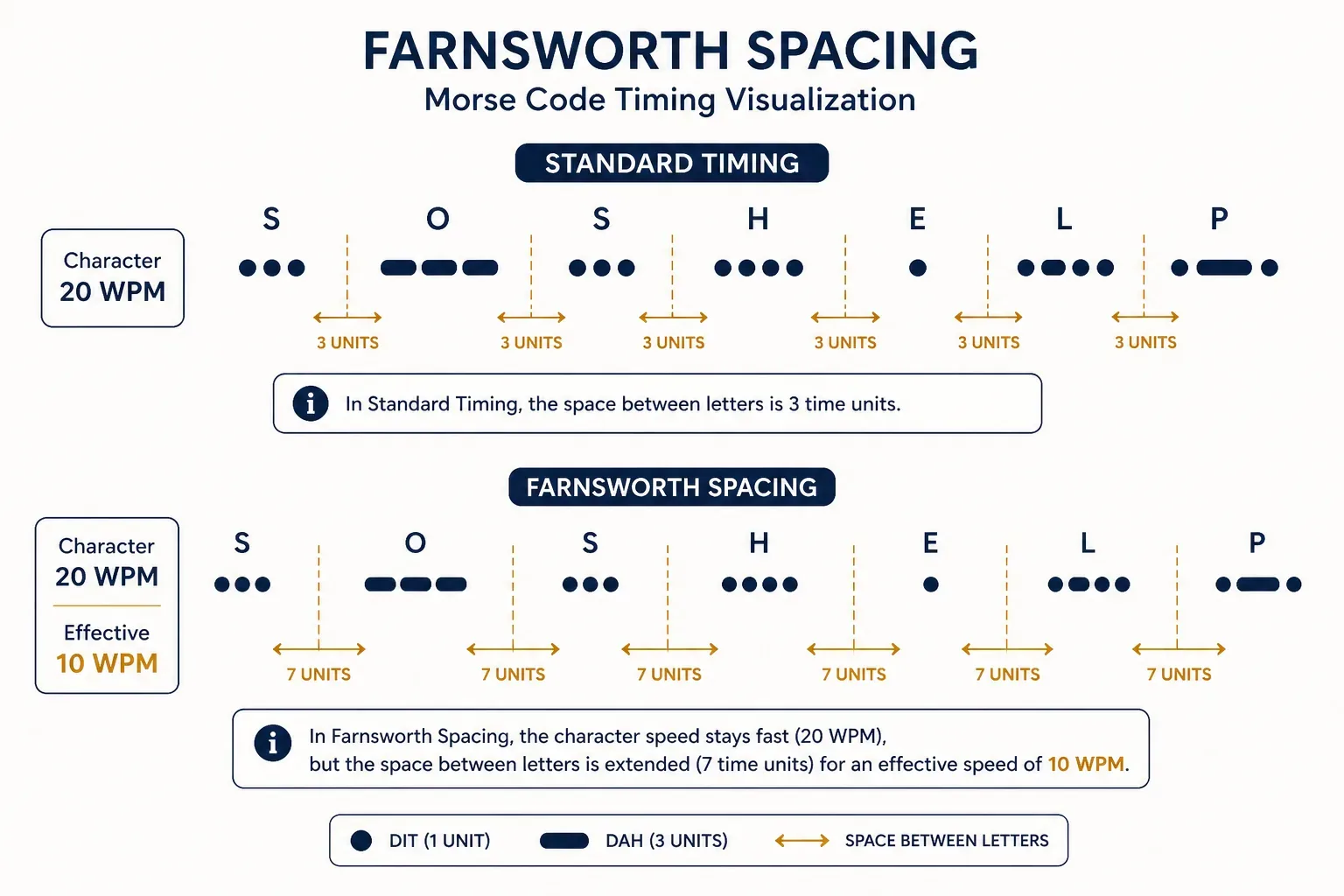
Farnsworth spacing sends Morse characters at full speed (typically 15–20 WPM) while lengthening the silence between characters and words so your effective copy rate is slower (often 8–10 WPM). Letters sound like real on-air CW; you get extra time to recognize each one. Enable it on our translator by setting character WPM to 20 and Farnsworth effective speed to 10 — the pairing this site uses for first-QSO practice.
What is Farnsworth spacing?
Farnsworth spacing (named for Donald Farnsworth, W6TTB) is a Morse training technique that decouples character element speed from overall words-per-minute rate. Dits and dahs stay short and crisp; inter-character and inter-word pauses are extended so learners process each letter without slowing the letter shapes themselves.
How Morse Timing Works: Dits, Dahs, and Spaces
International Morse (ITU-R M.1677-1) defines timing in unit multiples. Once you see the math, Farnsworth spacing makes intuitive sense.
| Element | Duration | Example at 20 WPM |
|---|---|---|
| Dit (dot) | 1 unit | ~60 ms |
| Dah (dash) | 3 units | ~180 ms |
| Gap within a character | 1 unit | Between elements of "C" (-.-.) |
| Gap between letters | 3 units (standard) | Stretched under Farnsworth |
| Gap between words | 7 units (standard) | Also stretched under Farnsworth |
At 20 WPM, the standard word "PARIS" (50 units) completes in one minute — that's your character speed. Farnsworth keeps those 50 units per word intact but inserts additional silence between letters so the same word might take two minutes to send at 10 WPM effective.
Why 20 WPM Characters + 10 WPM Effective Works
The 20/10 pairing is not arbitrary — it reflects how the human auditory system learns Morse. Below roughly 12–13 WPM, most people subconsciously count dits and dahs. Above 15 WPM, letters blur into recognizable "sound shapes" — the same phenomenon that lets you recognize a spoken word without spelling it.
20 WPM character speed
Each letter arrives with realistic rhythm. "Q" (--.-) sounds like one burst, not four timed elements. You build the same neural patterns you will use on HF nets and contest pileups.
10 WPM effective (Farnsworth gap)
The pause after each letter gives you time to write or say it aloud before the next one. Copy rate stays manageable while letter shapes stay fast.
Farnsworth vs Standard Timing
| Aspect | Standard 10 WPM | Farnsworth 20/10 |
|---|---|---|
| Dit length | Long (~120 ms) | Short (~60 ms) |
| Letter recognition | Counting tendency | Sound-shape listening |
| Copy rate | 10 WPM | 10 WPM effective |
| Transition to on-air CW | Large jump needed | Gradual gap reduction |
| Best for | Visual chart study | Audio-first learning |
How to Enable Farnsworth in the Translator
- 1. Open the free Morse code translator on morsecoder.us.
- 2. Set Speed to 20 WPM (character speed).
- 3. Toggle Farnsworth spacing on.
- 4. Set Farnsworth effective speed to 10 WPM.
- 5. Enter practice text — callsigns, Q-codes, or words from the trainer — and press Play.
- 6. Optional: download WAV for daily headphone sessions.
4-Week Farnsworth Practice Plan
Fifteen minutes daily beats hour-long weekend cram sessions. This plan pairs the translator with the Morse code trainer and the broader learn Morse code curriculum.
Week 1 — E, T, A, I, N at 20/10
Character Quiz in the trainer for these five letters. End each session with 5 minutes of random two- and three-letter groups on the translator with Farnsworth enabled.
Week 2 — Full alphabet, still 20/10
Add remaining letters via Koch progression. Practice common words (THE, AND, CODE) with Farnsworth audio. Target 90% accuracy before moving on.
Week 3 — Tighten to 20/13
Raise effective WPM to 13. Introduce numbers and basic prosigns. Run QSO Simulator drills at the new gap setting.
Week 4 — Farnsworth off at 15 WPM
Disable Farnsworth; run standard 15 WPM. If accuracy drops below 80%, drop to 20/15 Farnsworth for two more days, then retry. Read our Farnsworth vs Koch article for long-term progression.
People Also Ask
Who invented Farnsworth spacing?
The method is named after Donald Farnsworth, W6TTB, who developed it in the 1950s for U.S. military Morse training. The goal was the same as today: keep characters fast while giving learners processing time between them.
Does Farnsworth spacing work for numbers and prosigns?
Yes. Farnsworth affects timing, not content. Practice numbers, prosigns, and Q-codes the same way — fast elements, stretched gaps.
Can I use Farnsworth on the Morse code trainer?
The trainer focuses on recognition drills and Koch progression. Pair it with the translator's Farnsworth audio for listening practice between quiz sessions.
Farnsworth Spacing — Frequently Asked Questions
Practice Farnsworth Spacing Now
Set 20 WPM characters, 10 WPM gaps — free, no signup, ITU-accurate timing.
Open Morse Code Translator