Ham Radio Q-Codes Cheat Sheet
Q-codes are the shorthand every CW operator speaks. I still jot QTH and QSL on my logging sheet after forty years on the bands — they save time when conditions are noisy and every second counts.
Quick Answer: What Are Q-Codes?
Q-codes are three-letter ham radio abbreviations — QTH (location), QSO (contact), QSL (confirm), QRM (interference), QRN (static) — each with a question form and a statement form. On CW they compress routine exchange data so operators copy faster. This page lists the fourteen Q-codes you will hear on HF every week, with Morse patterns and example usage in real QSOs.
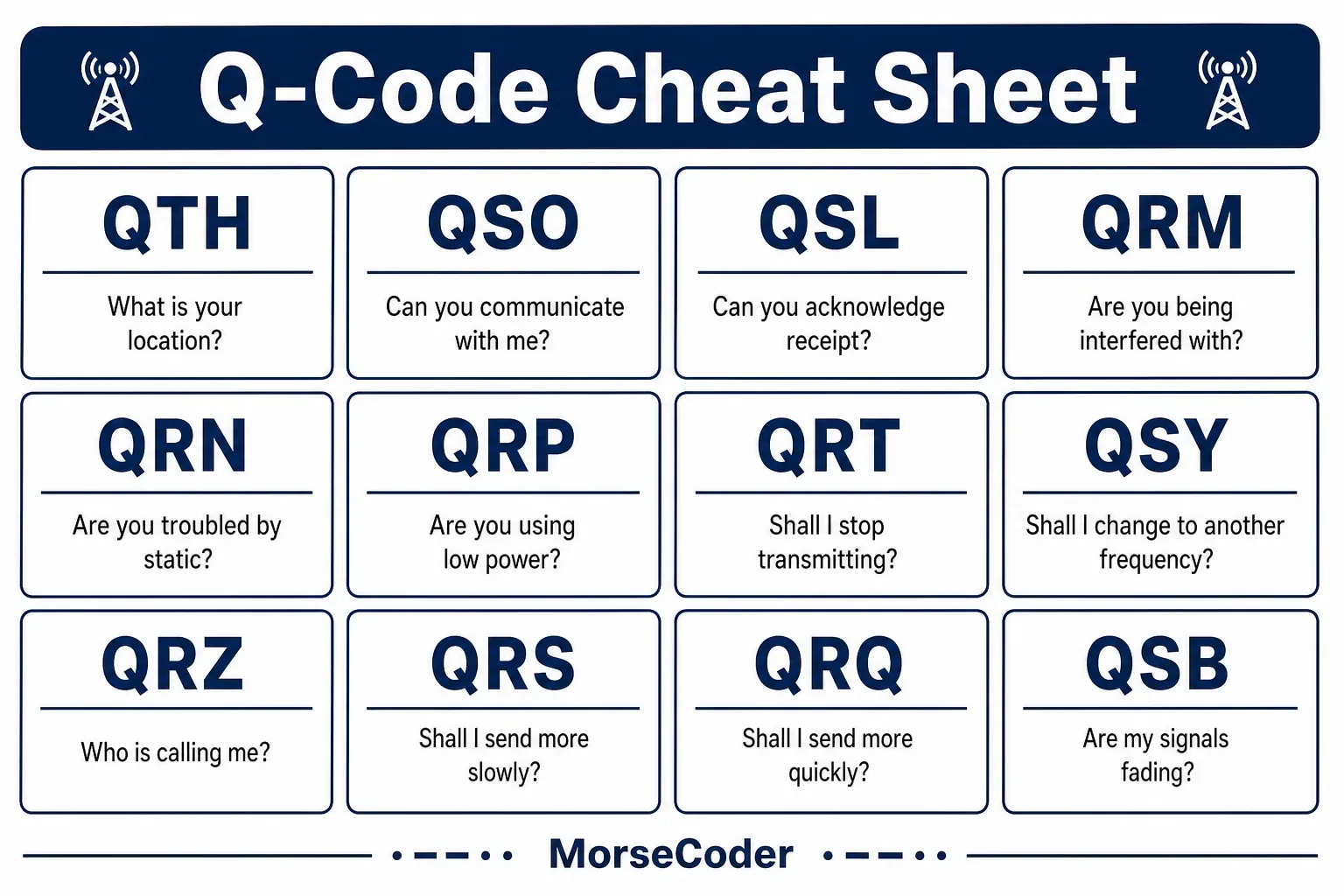
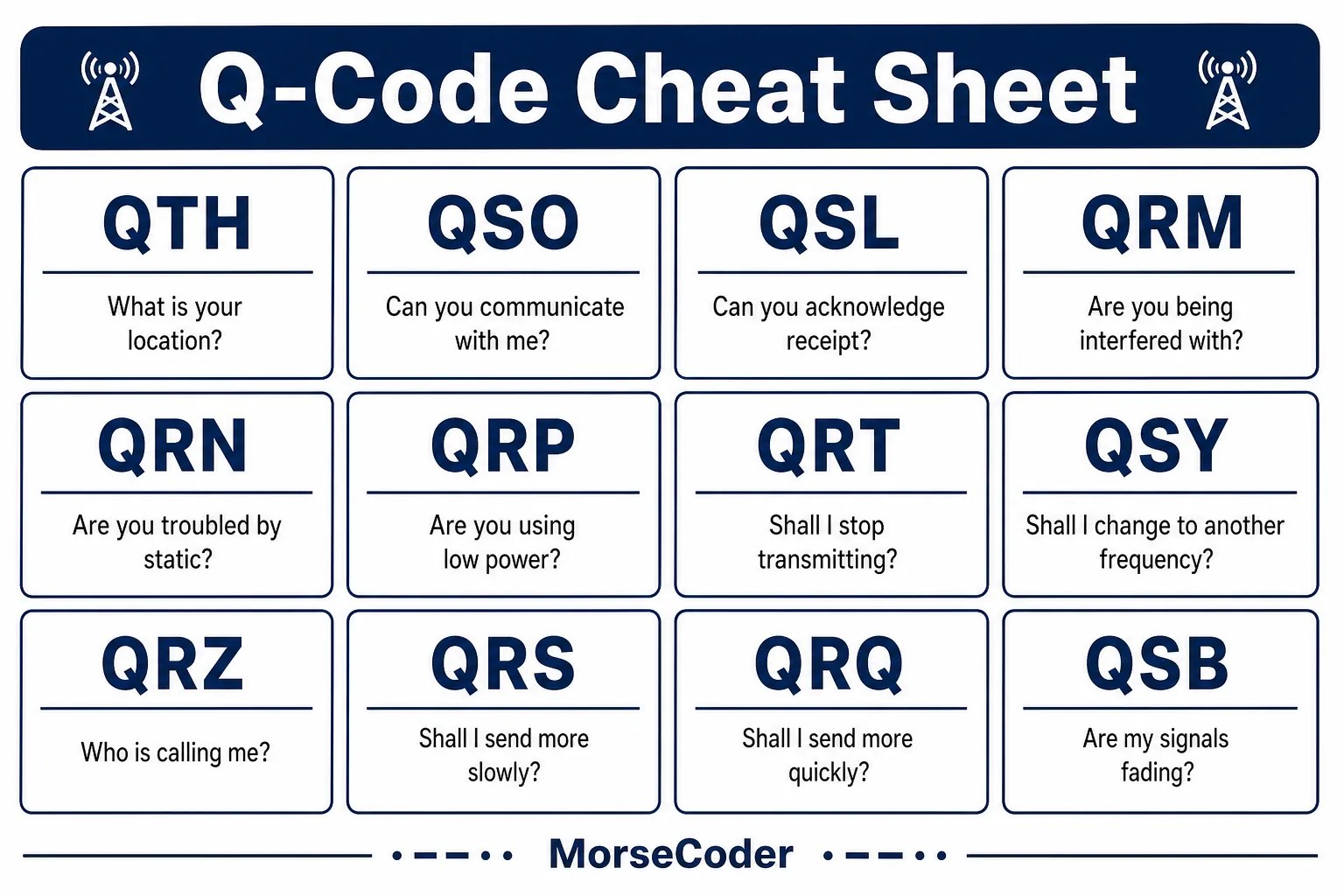
What is a Q-code?
A Q-code is a standardized three-letter brevity code from the early 20th century radiotelegraph service. The Q prefix marks it as a procedural abbreviation. On amateur CW, Q-codes are spelled with normal inter-letter spacing — unlike prosigns, which run together as one character.
Essential Q-Codes for CW Morse
| Code | Morse | Question Form | Statement Form |
|---|---|---|---|
| QTH | --.- - .... | What is your location? | My location is … |
| QSO | --.- ... --- | Can you communicate with … direct? | I can communicate with … direct. |
| QSL | --.- ... .-.. | Can you acknowledge receipt? | I acknowledge receipt. |
| QRM | --.- .-. -- | Are you being interfered with? | I am being interfered with. |
| QRN | --.- .-. -. | Are you troubled by static? | I am troubled by static. |
| QRP | --.- .-. .--. | Shall I decrease power? | Decrease power (low power op). |
| QRT | --.- .-. - | Shall I stop sending? | Stop sending / closing down. |
| QSY | --.- ... -.-- | Shall I change frequency? | Change frequency to … |
| QRZ | --.- .-. --.. | Who is calling me? | You are being called by … |
| QRX | --.- .-. -..- | Shall I standby? | Standby / please wait. |
| QSB | --.- ... -... | Are my signals fading? | Your signals are fading. |
| QRV | --.- .-. ...- | Are you ready? | I am ready. |
| QRS | --.- .-. ... | Shall I send more slowly? | Send more slowly. |
| QRQ | --.- .-. --.- | Shall I send faster? | Send faster. |
How Q-Codes Appear in CW QSOs
Q-codes sit inside ordinary message text, separated by prosigns and standard words. Here is a typical exchange annotated:
Station A: STATION B DE MORSECODER KN
Station B: MORSECODER DE STATION B FB UR RST 579 QSB QSB BT QTH PRACTICE LAB AR MORSECODER DE STATION B KN
Station A: STATION B DE MORSECODER QSL QSL BT QTH TRAINER DESK BT NAME OP AR STATION B DE MORSECODER KN
- QSB QSB — "you are fading" (statement, repeated for emphasis)
- QTH SPRINGFIELD MA — location answer without needing "QTH?" first
- QSL QSL — "copy confirmed" on the report
- BT — prosign separating report from name/QTH (see prosigns)
Question vs Statement: Reading Context
On phone, operators raise their voice at the end of a question. On CW, context and trailing punctuation carry the meaning:
Asking (question form)
QTH?— What is your location?QSL?— Did you copy my report?QRZ?— Who is calling?QRV?— Are you ready?PSE QRS— Please send slower
Answering (statement form)
QTH DENVER CO— My location is DenverQSL— Roger / confirmedQRN BAD— Heavy static hereQRT— Closing station nowQSY 14060— Moving to 14.060 MHz
QRM vs QRN vs QSB
Three codes newcomers confuse — they describe different problems:
| Code | Problem | Typical Cause |
|---|---|---|
| QRM | Man-made interference | Nearby stations, electronics, power-line noise |
| QRN | Natural static | Lightning, atmospheric noise, solar conditions |
| QSB | Signal fading | Multipath, ionospheric changes — signal strength varies |
Want more codes? Read our expanded Q-code cheat sheet blog post for traffic-handling and maritime entries.
People Also Ask
What does 73 mean with Q-codes?
73 means "best regards" — a traditional sign-off, often sent as ...--... ...--... or abbreviated. It usually precedes SK, not a Q-code.
Is QRP a Q-code or an operating style?
Both. QRP formally means "decrease power," but hams use it to label low-power operation (typically 5 watts or less on HF).
How many Q-codes exist?
The ITU and historical lists define dozens. This cheat sheet covers the fourteen you will hear weekly on HF CW; the blog post adds traffic-handling and maritime codes.