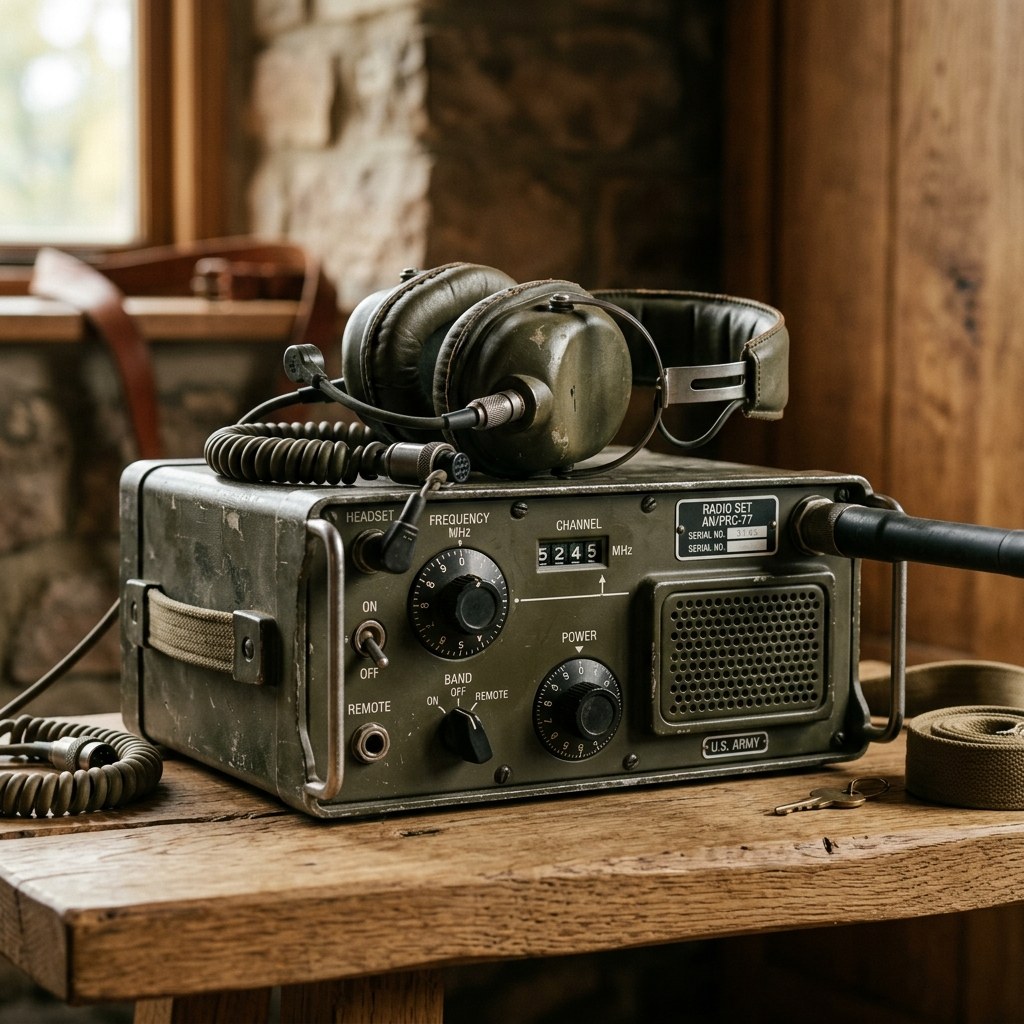
In 2022, the U.S. Navy did something that surprised headlines worldwide: it brought Morse code training back after a twenty-year gap. By 2026, that decision looks less like nostalgia and more like prescient engineering. Contested electromagnetic environments, satellite dependency risks, and lessons from Ukraine's communication challenges have validated what CW operators never stopped knowing — dots and dashes survive when everything else fails. Military and amateur Morse communities have been converging on the same conclusion from opposite directions. Here is why the Navy returned to Morse, what it means for 2026, and why civilians should pay attention.
What Happened: The 2022 Navy Revival
After discontinuing mandatory Morse training around 2002, the Navy determined that a generation of communications specialists lacked backup skills for environments where primary systems fail. The 2022 reintroduction targeted Information Warfare and signals personnel — not every sailor, but the specialists responsible for maintaining communication links under adversarial conditions.
Official reasoning centered on three factors: satellite vulnerability to anti-satellite weapons and jamming, GPS denial in contested theaters, and the need for low-probability-of-intercept communication methods that require minimal infrastructure. Morse code over HF radio addresses all three simultaneously.
The announcement generated viral debate — critics called it archaic; supporters cited historical resilience. Four years later in 2026, the critics have grown quieter. Real-world conflicts demonstrated exactly the communication fragility the Navy anticipated.
Contested Electromagnetic Environments
Modern warfare targets communication infrastructure aggressively. Electronic warfare units jam voice radio, disrupt satellite uplinks, spoof GPS signals, and disable cellular networks. Sophisticated militaries deploy these capabilities routinely; non-state actors use cheaper jammers with increasing effectiveness.
Morse code's advantages in this environment are structural, not sentimental:
- Narrow bandwidth: CW occupies roughly 150 Hz versus 2.4 kHz for voice SSB — harder to target and easier to copy through noise
- Low power effectiveness: A five-watt Morse signal can span oceans; voice at the same power often fails
- Human-in-the-loop: No dependency on digital protocols, encryption key management, or network routing
- Equipment simplicity: A basic transceiver, wire antenna, and battery suffice — no satellite terminal required
- Jam resistance: Skilled operators copy through interference that destroys voice intelligibility
These properties are documented in military communication doctrine and validated daily on amateur HF bands where CW contacts routinely succeed when SSB nets struggle during solar storms and contest congestion.
Historical Parallel: WWII to 2026
The Navy's Morse reliance peaked during World War II when radiotelegraph operators manned every ship and shore station. The Battle of the Atlantic, Pacific fleet coordination, and submarine communications all depended on CW. Post-war, voice radio and satellite systems gradually displaced Morse for routine traffic, and training programs shrank accordingly.
Yet Morse never fully disappeared. Ham radio operators preserved CW culture through contests, DXpeditions, and daily QSOs. The Morse Code in WWII article documents how dots and dashes shaped that conflict — history the Navy explicitly referenced when reviving training.
Our Morse Code History timeline traces the arc from Samuel Morse's 1844 demonstration through telegraph peak, radio era, near-extinction, and 2022 military revival. The pattern is clear: each communication revolution declares Morse dead; each major conflict or infrastructure crisis rediscovers it.
What Navy Morse Training Looks Like in 2026
Contemporary Navy Morse curriculum differs from 1940s radioman schools but shares core objectives: copy accurately under noise, send with correct timing, and operate field equipment without reliance on digital aids.
Training Components
- International Morse Code at five to thirteen WPM minimum for recognition
- HF radio setup, antenna deployment, and power management in field conditions
- Integration with broader signals intelligence and electronic warfare awareness
- Contingency communication planning when primary networks are denied
- Cross-training with amateur radio community resources and emergency communication protocols
Equipment Focus
Training emphasizes transferable skills rather than specific proprietary systems. Software-defined radios, portable HF transceivers, and standard CW keys mirror equipment available to licensed amateur operators. The Navy's message: the skill belongs to the operator, not the hardware vendor.
The Ham Radio Parallel
Amateur radio operators never stopped using Morse. In 2026, CW remains active on every HF band, with contest weekends generating hundreds of thousands of contacts and daily nets serving emergency communication groups worldwide. The Navy's revival created unexpected synergy:
- Military trainees practice on amateur bands (with appropriate licensing)
- Ham elmers mentor service members learning CW fundamentals
- Emergency communication organizations like ARES and RACES share protocols with military contingency planners
- Equipment developed for ham QRP operation informs military portable communication kits
Our Ham Radio Morse Code guide covers licensing paths that connect civilian and military communication communities. The ARRL reports steady CW interest among new licensees despite Morse no longer being an FCC exam requirement.
Why Civilians Should Still Learn Morse in 2026
The Navy's decision is a signal, not merely a military policy change. It acknowledges that over-dependence on fragile digital infrastructure creates systemic vulnerability civilians face equally.
Emergency Preparedness
When hurricanes destroy cell towers, earthquakes sever fiber lines, and wildfires knock out power grids, Morse over battery-powered HF radio reaches emergency services and family far beyond shouting distance. Learn SOS and basic phrases on our SOS guide and Survival Guide.
Amateur Radio Licensing
CW opens HF bands, DX opportunities, and contest participation. Many operators find Morse contacts more satisfying than phone — less interference, global reach, and a community that values skill development.
Cognitive Benefits
Morse training develops auditory processing, working memory, and pattern recognition. Research on musical training and language acquisition applies similarly to CW learning. Fifteen minutes daily produces measurable cognitive engagement regardless of military application.
Historical and Cultural Literacy
Understanding Morse connects you to nearly two centuries of communication history — telegraph networks, Titanic distress signals, WWII resistance communications, and space program backup systems. Our History Infographic visualizes this timeline.
Objections and Responses
"Satellites are more reliable now"
Satellites are reliable until they are targeted, jammed, or destroyed — events occurring in active conflict zones in 2024-2026. Morse provides redundancy, not replacement.
"Digital modes like FT8 are more efficient"
FT8 and similar modes excel in weak-signal conditions but require computers, synchronized clocks, and specific software. Morse works with a wire and a battery. Different tools for different failure modes.
"Nobody uses Morse commercially"
Correct for commercial telegraphy, irrelevant for contingency communication. The Navy does not train Morse for sending invoices — it trains for the day primary systems fail.
Getting Started: Navy-Inspired Training Path
Apply military training discipline to civilian learning:
- Week 1-2: Master SOS, E, T, A, I, N, S at five WPM using the trainer
- Week 3-4: Complete alphabet via Koch Method progression
- Month 2: Reach ten WPM with Farnsworth spacing — see our Farnsworth guide
- Month 3: First live QSO on amateur bands after licensing
- Ongoing: Daily copy practice, emergency phrase drills, equipment maintenance
Full beginner roadmap: Learn Morse Code. Compare training methods in our Farnsworth vs Koch analysis.
The 2026 Outlook
Morse code in 2026 occupies a unique position: officially obsolete by every commercial metric, actively taught by the U.S. Navy, thriving in amateur radio, and increasingly referenced in preparedness communities. The Navy's revival validated rather than created this reality.
Contested electromagnetic environments are not temporary wartime conditions — they define the communication landscape for infrastructure planning, military doctrine, and individual preparedness alike. A skill that transmits globally on five watts without satellites deserves a place in your toolkit even if you never wear a uniform.
I earned my license in 1998 and never stopped practicing CW. The Navy's 2022 decision confirmed what my grandfather taught me at eight years old: when everything else fails, dots and dashes still speak. In 2026, that lesson matters more than ever.